Before the Showroom: How the Reading Lamp Found Its Place
Explore the history of the reading lamp and learn how to place one for comfortable reading without lighting the entire room or crowding your favorite seat.
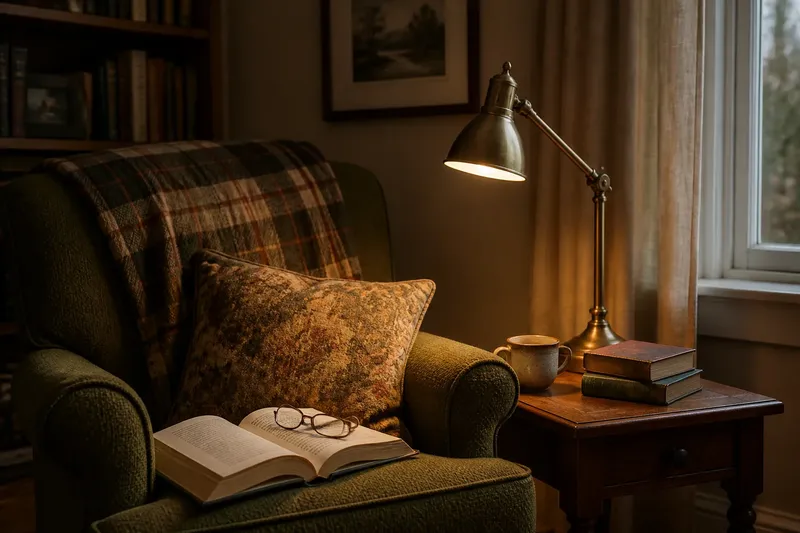
A reader settles into the same corner after supper, turns a small shade toward a book, and leaves the rest of the room softly lit. The reading lamp now seems to belong there, but its place in the home grew from a simple need: seeing a page without lighting every corner.
Why did a chair need its own light?
Before electric lamps became familiar household fixtures, people used several kinds of light at home, including hearths, candles, oil lamps, and gas lighting. Their placement shaped where reading and other close tasks took place. A reader might sit near a fire or bring a portable lamp to a table, rather than expect a separate light beside a favorite chair.
That arrangement linked reading to the household’s broader evening life. Someone might read aloud near the fire, mend clothing at a table, or keep a book open beside a candle used for other tasks. Light served several people and purposes, so its location shaped what could happen around it.
Portable flames offered more choice, though they required care. A candle needed a secure holder and distance from paper and fabric; an oil lamp needed fuel and a steady surface. Bringing light closer to a chair could make reading more convenient, but a dedicated reading lamp was not yet a routine fixture in every home.
What changed when electric lamps entered the room?
Electric lighting introduced a different kind of convenience: a lamp could be switched on without tending a flame. The timing and spread of household electrification varied by place and home, so there was no single moment when dedicated reading lamps became common. As electric fixtures became part of domestic interiors, a smaller lamp could supplement general room lighting and serve a particular seat or task.
Early electric fixtures took many forms. Some were decorative table lamps, some were attached to walls, and others supplemented a main light. A local lamp could be used for a brief reading session or a familiar evening routine without adjusting a flame.
The appeal was not simply brightness. One person could continue with a book while another spoke, rested, or took up a quieter task nearby. A lamp gave reading a small territory of its own without requiring the whole room to follow suit.
How did a reading lamp become part of the furniture?
A lamp becomes part of a room’s arrangement when it is placed in relation to the reader, not merely set on an available surface. A table lamp beside an armchair, a floor lamp behind its shoulder, and a wall-mounted fixture above a reading seat each create a different relationship between light, furniture, and movement.
A comfortable chair and a nearby side table make an inviting reading place: the surface can hold a book, spectacles, or a cup. The lamp completes the arrangement by bringing light close to the page. Its position matters as much as its style.
Shade design helps distinguish a reading lamp from a source meant to illuminate the whole room. A shade can direct light toward a book and limit glare in the reader’s eyes. Adjustable arms and swiveling shades offer more control, while a fixed shade may work well when the reader and chair tend to stay in the same positions.
How did focused light become an evening habit?
Once a lamp was placed beside a favored seat, the room could support a repeatable evening ritual. A reader could reach for a switch, open a book, and settle in without rearranging the furniture or changing the lighting everywhere else. The convenience was modest, but repetition made it feel essential.
A reading lamp can also help people share a room without sharing one activity. One person might read while another knits, listens to the radio, or prepares for bed. A pool of light serves the reader while the surrounding room stays less brightly lit.
Imagine a household with one bright ceiling fixture and a chair beside a window. Someone adds a shaded lamp to a narrow table beside the chair, then switches it on after dinner. The book is easier to see, while the ceiling light can stay off; the tradeoff is that the rest of the room remains dimmer, so people moving through it may prefer to switch on general lighting.
What should you check before choosing a reading lamp?
Start with the seat and the way it is used. A lamp that suits an upright chair may feel awkward beside a deep recliner, and a floor lamp may make more sense where there is no room for a side table.
- Seat position: Check whether the reader sits upright, reclines, or shifts often. If the position changes, choose an adjustable shade or arm; if it stays consistent, a fixed lamp may be simpler.
- Available surface: Check whether a side table has clear, stable space for a lamp. If it does, a table lamp can keep the light close; if it is crowded or absent, consider a floor lamp instead.
- Shade direction: Check whether the shade directs light toward the page without shining into the reader’s eyes. If it does, keep that style in mind; if it causes glare, look for a different shape or an adjustable head.
- Reach to the switch: Check whether the switch can be reached from the seated position. If it can, the lamp will be easy to use; if not, consider a different switch location or a fixture with a more accessible control.
- Other room lighting: Check whether the reading lamp leaves paths and nearby surfaces too dim for shared use. If it does, use general lighting as well; if not, the localized lamp may be enough for that activity.
- Fixture condition and instructions: Check the lamp’s label, shade compatibility, and visible condition. If the fixture is damaged or wiring is in question, stop using it and ask a qualified professional; if it is intact, follow the manufacturer’s care and bulb guidance.
These checks are more useful than choosing by appearance alone: they connect the lamp to the seat, the reader, and the room around them.
What do readers ask about the reading lamp?
When did reading lamps become common in homes?
There was no single moment when every household adopted one. Access to electric lighting and the availability of suitable fixtures varied, so the reading lamp became familiar gradually and unevenly.
Is a reading lamp different from a table lamp?
Not necessarily: many table lamps serve as reading lamps because they sit beside a chair or bed and direct light toward a page. The difference is chiefly in placement and purpose, rather than the object’s name or shape.
Why is a shaded lamp often used for reading?
A shade can direct light toward a book and limit light shining into the reader’s eyes. Its effect depends on the shade’s material, shape, and position, so the reader’s view matters as much as the fixture’s appearance.
Can a reading lamp be the room’s only light?
It can serve a reading area, but a single localized source may leave other parts of the room dim. Use general lighting too if people need to move around or share the room comfortably.
How can the lamp’s history help you place one?
The reading lamp’s history is a story of light moving closer to the activity it serves. Hearths and portable flames provided shared or movable light; electric fixtures made it possible to switch on a local source without tending a flame. The familiar lamp beside a chair carries that practical idea forward.
Say you read in an armchair, keep your book on a side table, and find that the ceiling fixture feels too bright for a quiet evening. First, check whether the table has clear, stable space; if it does, a table lamp is an option. Next, sit in the chair and check whether the shade can point toward the book without shining into your eyes; if it cannot, an adjustable lamp or a different placement is a better fit. Finally, reach for the switch from the seat; if it is awkward to reach, choose a more accessible control or position. The resulting choice is a table lamp only if the surface, light direction, and switch all suit the routine; otherwise, a floor lamp or another location may work better.
Before choosing a fixture, spend an evening noticing where reading already happens, where the book rests, and which switch is easiest to reach. That small observation connects the reading lamp’s history to its present purpose: making a familiar seat ready when the next chapter begins.