The Guest-Ready Room Is Not a Standard
A guest-ready room can serve daily household needs without losing its welcome. Decide what to keep clear, what to store, and what can move when guests arrive.
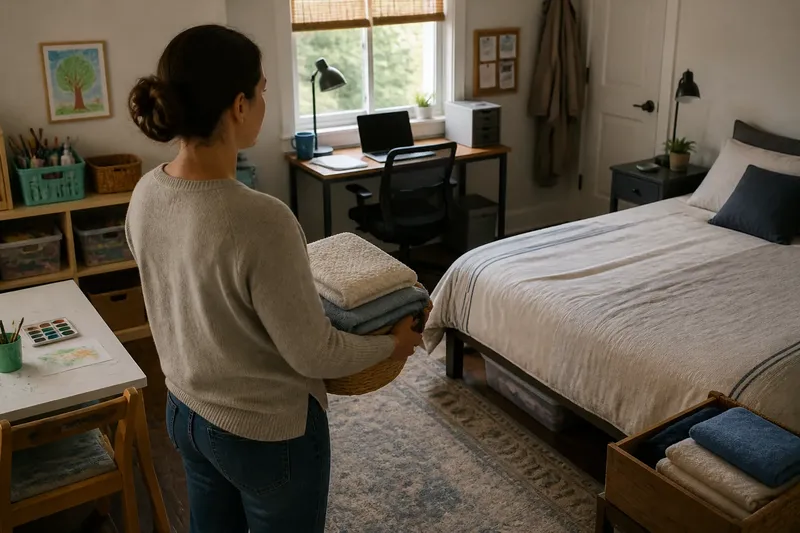
On Sunday evening, Mara carries a basket of clean laundry into the spare room and pauses beside the bed. The folded duvet is neat, the bedside table is bare, and a stack of craft supplies has nowhere to go. A friend may visit next month, but the room has been kept half-empty for weeks. Mara wonders whether being a good host means preserving a guest-ready room every day.
It does not. In this invented, hypothetical situation, Mara shares a small home with her partner, who works remotely, and their child, who needs a place for art projects. The spare room is also the only quiet spot for video calls and the household’s overflow storage. Their challenge is not to stage the room perfectly; it is to agree on what “ready” needs to mean for their actual guests and routines.
What does a guest-ready room need to do?
Mara starts by asking what a visitor needs to feel comfortable, rather than what a guest room in a catalog is supposed to look like. Their friends usually stay for a night or two, bring their own toiletries, and are happy to share the family bathroom. They need a clean place to sleep, somewhere to put a bag, a lamp they can reach, and a little privacy.
That short list changes the room’s job. It does not need to look untouched; it needs to be convertible without a scramble. Mara and her partner choose a modest baseline: keep the bed clear enough to make, leave one drawer available, and preserve access to the lamp and outlet. The desk, art materials, and labeled storage bins can stay when no one is visiting.
They also ask guests directly about preferences when arranging a stay. A visitor who needs a quiet workspace, has mobility considerations, or travels with a small child may need something different. The household can respond to the person in front of them instead of trying to anticipate every possible request all year.
How can the room serve daily life between visits?
Mara’s partner uses the desk for calls, while their child paints at a folding table. The family decides these are legitimate uses of the room, not evidence that they have failed at hospitality. They give each activity a home: a shallow drawer for charging cables and notebooks, a lidded art caddy for paints and brushes, and a basket for clean bedding.
Nothing needs to disappear into an elaborate storage system. The point is that household items have defined places and can be moved without sorting through unrelated clutter. The art caddy sits on a low shelf, and the desk chair tucks under the desk so the bed remains accessible.
Say the family expects a friend to arrive on Friday, and the art table is covered with a drawing in progress. They agree to move the caddy and unfinished work to a designated shelf, wipe the table, and clear the bed before the visit. The expected result is a usable surface and a welcoming sleeping space, with the child’s project kept intact rather than shoved into a random cupboard.
A room that supports the household on ordinary days is less likely to become a guilt-inducing display. Keep the useful items that belong there, but make their places easy to clear.
What can be prepared only when someone is coming?
The family separates everyday readiness from arrival-day preparation. Everyday readiness is limited to keeping bedding clean and the route to the bed open. When a visit is confirmed, they add fresh sheets, a towel, a glass, and a small note about the bathroom light switch.
This distinction prevents the room from being perpetually staged. There is no need to leave a towel folded on the bed or a decorative tray waiting for an uncertain visit. Those touches can be added when they will be useful, then returned to their ordinary places afterward.
Mara also checks the practical details that guests may not think to ask about: where to hang a coat, how to close the blinds, and which outlet is easiest to reach. A small card in the drawer holds the Wi-Fi name and the household’s usual morning routine. It is information, not a hotel-style performance.
How do you decide what belongs in the room?
Mara and her partner make decisions by asking whether an item supports a regular household activity, makes a confirmed visit more comfortable, or is simply waiting for a permanent home. The first two categories can stay if they fit. The last category gets handled elsewhere rather than quietly becoming the room’s purpose.
- Keep: Items used often in the room, such as the desk lamp or art caddy.
- Store: Guest bedding and towels in a clean, reachable place.
- Move: Work in progress or desk supplies when a visit is arranged.
- Remove: Boxes and belongings that have no clear use in the room.
- Ask: Guests about needs that could change how the room should be prepared.
They do not buy new furniture to make the arrangement feel official. A drawer organizer keeps small items together, and a hook on the back of the door holds a spare robe. If either addition starts to make the room harder to use, they can take it away.
What questions help set a realistic guest-ready room?
Does a guest room need to stay empty?
No. A room can serve work, hobbies, or storage between visits if guests can still use its essential features. Decide which items move when a stay is scheduled and where they will go.
What should stay ready all the time?
Keep only what reduces effort without getting in the household’s way, such as clean bedding stored nearby or a clear path to the bed. Fresh towels and small comforts can wait until a visit is confirmed.
How much notice is enough to prepare?
That depends on the room and the household’s schedule, so ask guests when they plan to arrive and agree on a preparation window that feels manageable. A simple plan for moving daily items is more useful than promising a perfectly staged space.
What if a guest needs something the room cannot provide?
Talk about the limitation before the visit and consider a practical alternative, such as another sleeping arrangement or a different room. For needs involving health, accessibility, or safety, ask the guest what would help rather than guessing.
What changed by the time the friend arrived?
For Mara’s friend’s visit, the family cleared the folding table, put the art caddy on its shelf, and made the bed with clean sheets. They left the desk in place because the friend might want to check messages, and they cleared the drawer for a bag. The room still looked like part of a lived-in home, but its sleeping and storage functions were easy to use.
After the visit, the family returned the art supplies to the table and used the bedding basket for the sheets that needed washing. They did not preserve a staged version of the room once the guest had left. The household had made room for a visitor without giving up the room’s daily purpose.
A guest-ready room is not a standard that every household must meet; it is an arrangement that fits the people who live there and the guests they actually welcome. In Mara’s home, the useful measure is whether a confirmed visit can be prepared with a clear plan and ordinary effort. Start with the needs of your next likely guest, and let the room remain yours the rest of the time.